Insights
There is a claim that serious readers of fiction have always felt to be true and that literary critics have always struggled to justify rigorously: that novels know things. Not merely that novels contain information — biographical data, historical detail, social description — but that the sustained imaginative inhabitation of other minds that reading serious fiction requires produces a form of understanding that is distinct from, and in some respects deeper than, the understanding produced by philosophical argument, sociological analysis, or historical narrative. The claim is intuitively compelling. It is also, on examination, more philosophically complex than it initially appears.
Henry James, whose prefaces to his collected works constitute the most sustained reflection on the novel’s cognitive ambitions by any practitioner of the form, argued that the novel’s distinctive capacity was the rendering of consciousness from within — the ability to place the reader inside the perspective of a character with such precision and density that the reader experiences not merely the events of the character’s life but the quality of mind through which those events are filtered.
This is what James meant by his demand that the novelist be one on whom nothing is lost: not encyclopaedic knowledge but a fineness of attention to the texture of experience. The novel’s knowledge, on this account, is knowledge of what it is like — phenomenological rather than propositional, enacted rather than stated.
The philosopher Martha Nussbaum developed James’s intuition into a systematic argument in Love’s Knowledge and Poetic Justice. Nussbaum argued that certain moral truths — truths about the particularity of persons, the complexity of moral situations, and the irreducibility of human emotion to abstract principle — are not merely illustrated by literature but can only be adequately expressed and understood through the literary form.
The attempt to reduce these truths to philosophical propositions inevitably loses what is essential: the particularity of the case, the thickness of context, the quality of the emotional response. Novels are not philosophy illustrated by story. They are a distinct cognitive instrument whose formal properties — character, plot, narrative perspective, the management of time and detail — are themselves the means by which certain kinds of truth are made accessible.
The postcolonial novelist and critic Chinua Achebe pressed a related argument from a different direction. In his celebrated 1977 essay on Conrad’s Heart of Darkness, Achebe argued that the novel’s capacity to render consciousness from within was also its most dangerous power: it could confer on one perspective the authority of depth, interiority, and fully realised humanity, while denying that interiority to others. The African characters of Heart of Darkness are not rendered from within.
They are seen from without — as figures in a landscape, embodiments of a primordial darkness against which Kurtz’s European consciousness is defined. The novel’s formal power to make one perspective feel universal is not merely an aesthetic achievement. It is a political act — one that has shaped how millions of readers have understood Africa, colonialism, and the humanity of its people.
Achebe’s own novels — Things Fall Apart above all — were in part a response to this appropriation of the novel’s cognitive authority. By rendering Igbo life and consciousness from within, with the same density and interiority that the European novel had reserved for European experience, Achebe was not merely providing a corrective historical record.
He was asserting a claim about who counts as a subject of novelistic attention — whose inner life is complex enough, whose moral world is thick enough, to sustain the full cognitive and formal apparatus of the serious novel. The political dimension of novelistic form is inseparable from the epistemological one: the question of what the novel knows is always also a question of whose experience counts as knowledge.
The critic Franco Moretti offered a structural complement to these arguments through his concept of distant reading — the analysis of large corpora of literary texts using quantitative methods rather than the close reading of individual works. Moretti’s provocation was that the individual novel, however rich, gives access only to the particular, while patterns in the production, circulation, and formal conventions of thousands of novels reveal the deep structures through which literary culture reproduces social norms, ideological assumptions, and cognitive habits across time and geography.
The knowledge that the novel produces, on this account, is not only in the text but in the patterns of its production — in what gets written, published, translated, and read, and what does not.
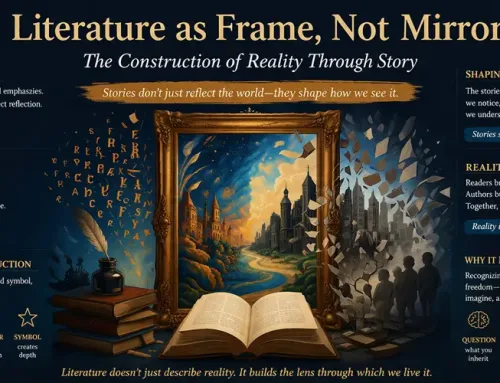
These arguments converge on a conclusion that is at once exhilarating and unsettling: the knowledge that novels produce is real, but it is not neutral. It is shaped by the perspective from which it is rendered, the formal conventions through which it is structured, the markets and institutions through which it circulates, and the interpretive communities that receive and value it. The novel does not simply reflect human experience. It selects from it, frames it, and confers on certain experiences the authority of full artistic attention while passing others over in silence or rendering them as background.
The deepest question that literary criticism raises is therefore not whether novels know things — they clearly do — but whose knowledge counts, whose experience receives the full formal apparatus of artistic attention, and whose is relegated to the margins. This is not a question that can be answered by any individual novel, however great. It is a question about the ecology of literary production — about which voices the literary culture of any given moment makes it possible to hear.